If the information you are seeking is not on this page, use the search
box below to search this site. When searching, you do not need to enter the word
"Trinidad" in your search.
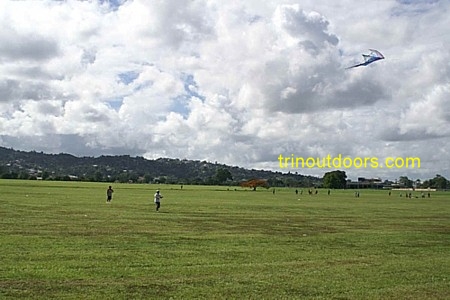
With the passage of time we see less of the old time kites made of paper
and bamboo or coconut fronds held together by a flour paste glue with a tail made of
strips of cloth. However kite flying still has some popularity especially among children.
In addition adults are often seen, at the beach, flying kites.
The chookie chong, which is a kite made from notebook paper with a tail
also made from notebook paper, is the easiest kite style to make and was probably the
first type of kite that most children learned to fly. Even today little children can
sometimes still be seen flying a chookie chong around their home. The most commonly used
design for a kite was the diamond shape. This kite style requires a long tail for
stability and flies at a low angle. On these kites the longer the tail, the higher the
kite will fly. The madbull is always held in awe as it is a very large kite that was and
is generally flown by teenagers and adults because it requires some strength to hold the
string. The madbull kite has objects
attached that cause it to make a whirring or buzzing sound as it flies. One type of kite
that is always admired in Trinidad is the fighter kite. This kite is designed to cut
the strings of other kites as they fly, using sharp objects such as crushed glass or razor
blades glued to its string.
Part of the excitement of kite flying arose from
the task of creating the kite, which involved choosing the paper, deciding how to
decorate, making the tail, getting the string. Most of the kites used today are purchased
from vendors and made of plastic. Although the excitement of creation is gone, kite flying
is still an enjoyable past time.
The peak period for kite flying is February to May because of the
constant winds during that period. Similar to other Caribbean countries, there is a large
kite flying competition each year during April (usually on Easter Sunday at the Queen's
Park Savannah) and other smaller competitions at other times such as the Tobago Kite
Flying Festival on December 26th.
Below is some of the excitement from the Easter 2018 Kite
Flying Competition at the Queen's Park Savannah.
To learn about the various kite flying competitions visit our Events Calendar
Trinidad has become one of the premier countries to view the nesting of leatherback
turtles. The nesting season runs from March to September with May & June being the
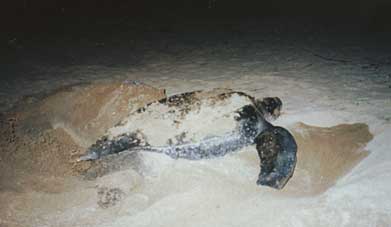
months of highest concentration. The leatherback turtle is the most visually dramatic of
the turtles that nest in Trinidad because of their size.Adults
can vary in size from 600 pounds to 2,000 pounds. Nesting takes place at
night and only the female comes to land. The female leatherback turtle
always returns to the same beach where they were born for laying their eggs. On the beach
the female turtle will dig an egg chamber with her flippers and then lay between 80 to 100
eggs. After laying, the female leatherback covers the chamber with sand and
then smoothes over the area to disguise the chamber. A female will visit and lay up to
eight times during the nesting season.
Nesting takes place on Atlantic beaches that have heavy surf, a steep profile and
coarse sand. The beaches on which nesting turtles are found are Maracas,
Las Cuevas, Blanchisseuse, Grande Riverie, Sans
Souci, Guayamara, Mission,
Patience Bay, Tompire, Rincon, Matura, Fishing Pond
and Manzanilla. The prime nesting sites are at Matura and Grande
Riverie and permits are required for visiting these beaches at night during the
nesting season as well as at Rincon and Fishing Pond.
Grande Riverie is the
premier site for viewing the nesting turtles. This popularity is due to
the fact that the largest number of leatherback turtles comes to
this beach which is partly caused by the conservation efforts in
this area. Set on the grounds of a former estate, very near to the beach, is a small
visitor center (telephone number 868-670-4256) with a cocoa drying shed. Many of the trees
around the center are labeled so you are able to learn the names. Permits can be obtained
at the visitor center and there are licensed guides to oversee the nesting and explain the
process. There are several hotels on the beach so that visitors can sleep over if they are
too tired for the return journey. It should be noted however that turtle watching is a
very popular activity and the hotels are often fully booked on weekends, so reservations
are advised.
Big Bay at Sans Souci is also a turtle nesting site and receives
the four other species of sea turtles in addition to the leatherback turtle. One can
arrange to view the turtle nesting at Sans Souci by
calling the Sans Souci Community Turtle Tour Guides at 868-670-1505.
The beaches at Guayama,
Mission,
Patience Bay, Tompire are not well known for receiving leather
back turtles however these turtles also nest on these beaches. The Tompire
beach is on the outskirts of Cumana village and gets its name from the river that
crosses the Toco Main Road just before one enters Cumana village.
The Guyamara Beach
lies between Rampanalgas Village and Cumana Village and is highly accessible
as it is immediately next to the main road. The heavy surf and steep profile
of this beach make it suited for leatherback turtles to heave their
tremendous weight out of the water and onto the sand. While turtles
definitely nest at this beach and towards the end of the nesting season one
can see discarded egg shells there is not a high incidence of nesting,
possibly because the frequent car headlights passing along the road
discourages the turtles from coming out of the water. These beaches are
patrolled at night during the nesting season by the Toco Turtle Protection Programme
(TTPP) to ensure the protection of the nesting turtles. To view the nesting on these
beaches you can contact the TTPP at 868-670-0068 or email tfprojects@tstt.net.tt. The TTPP also conducts
nightly patrols at Big Bay Sans Souci.
Matura Beach is another popular location because
of the tours run by Nature Seekers, a community based environmental protection group. At
the starting point for the Matura beach tours there is a small visitor centre with toilet
facilities that are open when tours are being conducted. The Beaches Page has directions for finding Matura Beach.
Permits for viewing the nesting of the leatherback turtle can be obtained from the
Forestry Division at
Long Circular Road, Port of Spain - 622-7476
Bailiser Avenue, Pleasantville, San Fernando - 657-7357
Damarie Hill, Sangre Grande - 668-3825
Maracas, Las Cuevas,Blanchisseuse and Manzanilla receive occasional nesting turtles.
Las Cuevas Bay has
not traditionally been known as a major turtle nesting site, however
leatherback turtles have been nesting at this bay, particularly at the far
western end of the bay. For persons living or staying within Port of Spain
and its environs this beach has the advantage of being in easy driving
distance being approximately 45 minutes away. The months of May and June
have the heaviest concentration of nesting turtles at this Bay and it is
reported that hundreds of turtles come to nest. The Las Cuevas Eco-Friendly
Association (868-309-0113) arranges guided tours for turtle watching at Las
Cuevas.
The
number of turtles nesting at Manzanilla is not as great as at Grande Riverie or at Matura,
however leatherback turtles have been reported as nesting on this beach since the 1880's.
During the months of March to August, the Manzanilla Beach is closed to the public during
the hours of 6pm to 6am to protect the turtles. Persons wanting to view the turtle nesting
at Manzanilla should go to the orientation site at the "Breakaway" area along
the Cocal Stretch.
Paria Beach, Madamas Beach and Gran Tacarib are also nesting sites for Leatherback
turtles. These beaches are only accessible by boat or via a forest hike.
Photo by Ricardo La Borde
I
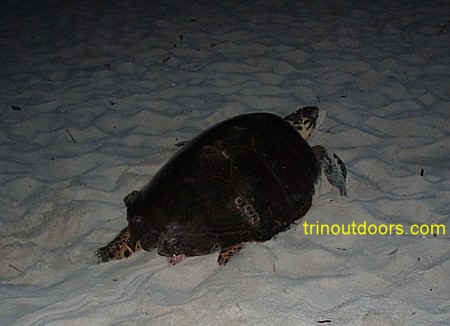
n addition to the leatherback, four other sea
turtles nest on the beaches of Trinidad and Tobago and these are:
Viewing turtle hatching while not as dramatic as the nesting is also an enjoyable
activity. The young turtles begin hatching approximately 60 days after the eggs are laid. As soon as they hatch the young turtles climb through the sand onto the
beach and immediately head for the water. Upon entering the sea, the young turtles head
for deep water. The young females will then remain at sea until they are sexually mature
at approximately 15 years.
Crayfish also called Crawfish and also called river shrimp or freshwater
shrimp is a delectable crustacean. Catching crayfish has been a vacation
activity for many a family and for legions of young boys on school holidays
providing hours of clean cool fun. There are four species of crayfish in
Trinidad with differences in size and the color varying from blue, green,
grey, to yellow with dark brown stripes. Crayfish eggs are carried
downstream by the river currents to the sea where they develop into larval
stage and then they return as juveniles up the river to live their remaining
lives.
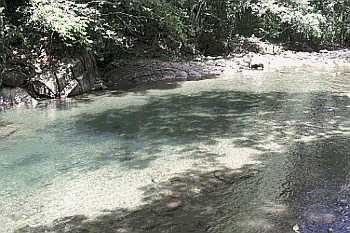
Crayfish live in clear fresh water and so the streams from Trinidad's
Northern Range are the areas for finding these freshwater shrimp. The rivers
that flow out into the Atlantic Ocean in areas such as Rincon,
Las Cuevas
and Blanchissuesse on Trinidad's north coast and in areas such as Salybia,
Rampanalgas,
Cumana, Toco,
Gran Riverie and Matelot on Trinidad's north-east
coast are the favored haunts of those seeking this crustacean. While
catching crayfish can be done in the day, this is usually a night time
activity as these freshwater shrimp are largely nocturnal. The task of
catching them can be a hilarious activity especially when done in a group
with someone who is a novice as crawfish move swiftly and have a high
sensitivity to vibrations in the water that is detected by the sensory
antennae on their head. One of the humorous aspects of catching crayfish is
that they test everything with their pincers and so may nibble at your toes
or legs when you are in the water. It can be quite funny to see someone
jumping out of the water because of a pinch from a crayfish.
Crayfish tend to rest under rocks in both shallow and deep water or near
the river banks where the vegetation overhangs the river as this provides
them protection from predators and their coloration allows them to blend
well against the rocks. When they spot prey such as smaller fish, shrimps,
worms and insect larvae or flying insects such as small dragonflies that
come near the water surface they dart out from their hiding place.
The normal tool for catching these freshwater lobsters is either a small
three pronged fork or a small net on a pole or both. Of course as catching
crayfish is a nighttime activity you must have a light to see them and
usually the telltale sign of their presence are their eyes that glow red in
the light. The most common method for catching them is to spot them in the
water and either quickly scooping them up with the net or spear them with
the fork but you must be quick because they certainly move fast. Some
persons catch crayfish using bait such as chicken, liver or fish tied to a
string and pulling the crayfish out of the water when it holds on to the
bait with its pincers. Another technique that is
used by some to attract the crayfish is to spread a small amount of grated
coconut on the water and then scoop them up as they are drawn to the surface
by the grated coconut.
Crab catching is an engaging recreational activity especially when the crabs are caught
for eating. The main crabs used as food in Trinidad are land crabs known as the Blue Crab
and the Hairy Crab. The Blue Crab generally lives in muddy places and the Hairy Crab
usually lives in swampy places. A third type of crab that is eaten, though much less often
because of its habitat, is the Manicou Crab, which is a brown, terrestrial mountain crab
that lives in the forest.
One of the methods used for catching these crabs is to use a trap and these are usually
made of wood, bamboo or wire. Despite the material that the trap is made of, the concept
of the design is the same. The trap has a door that is open, but when the crab takes the
bait that is in the trap the door either drops shut or falls shut and cannot be opened by
the crab from the inside. To attract the crab, bait of either dried coconut meat or large
pieces of hot pepper are placed in the trap.
Another method that is used, but is one for the really brave, is to spot the crab entering
its hole and then to push your hand into the hole and grab the crab. The claim made by
those who use this method is that the crab cannot open its claws in the hole and so cannot
pinch very hard.
Probably the most enjoyable way to catch land crabs is to grab them with your hands as
they come out of their holes and traverse the beach. The best time for indulging in this
method of catching land crabs is at night during a full moon with a high tide. During this
time the crabs come out their holes and cross the beach to release their eggs in the sea.
They can thus be caught going to the sea or returning after releasing their eggs. This
method, if done with friends, can result in hours of entertainment and is guaranteed to
result in laughter especially if some one does not hold the crab properly or firmly. The
safest method for catching the crab is to grab the crab from behind using the thumb and
index finger and holding the crab by the body with the fingers positioned behind the
pincers (gundy). This method is safe because the crab cannot reach behind itself with it's
pincers. Areas that are mangrove fronted by a beach are prime areas for this activity as
they generally have a large population of crabs. Manzanilla
and Mayaro are two areas that are well known for
this type of crab catching and many individuals engage in this night time activity while
on vacation at these beaches.
After catching the crabs some people keep them in a barrel for 3 or 4 days and feed them
lettuce. The reasoning advanced for doing this is to purge the crabs of all the rotted
material that the crab may have eaten previously.
Catching marine swimming crabs is also very popular. Individuals use a piece of chicken on
a line dangled in the water and when the crab takes hold of the chicken the line is pulled
out of the water and a flattened basket (usually the metal or plastic cover from a fan) is
slipped under to catch the crab if it lets go of the bait when it comes out of the water.
The canals along the Uriah
Butler Highway are one of the places that is popular for catching these crabs.
Archery is the art, practice, or skill of propelling arrows with the use of
a bow. Historically archery has been used for hunting and combat although
throughout most of the world archery is now simply a recreational activity
and is probably the oldest sport now practiced, dating back as far as 50,000
years BC. Target archery is the most popular form of archery, in which
members shoot at stationary circular targets at varying distances ranging
from 30 meters to 90 meters outdoors and 18 and 25 meters indoors.
In
Trinidad and Tobago archery is a relatively new sport, although our
Amerindian ancestors certainly practiced it for hunting and defense.
Although new it is a growing sport.
There are presently 4 archery clubs in Trinidad; Southern Bowtech Club of
Gasparillo; the Central Precision Archery Club of Chaguanas; Elite Archery
Club of Tunapuna; and Points Archery Club of Chaguaramas. These clubs
operate under the Trinidad and Tobago Target Archery Federation (TTTAF),
which maintains an archery field at Tucker Valley, Chaguaramas and this
range is named after Micheal P. Mackenzie, one of the first local archers
and a founding member of the federation.
This
range is available to all members of the federation without charge. At the
clubs beginners, starting from 10 years, are provided with entry level
equipment which includes bow, arrows, targets and some protective gear and
of course training. But it’s not just a youth sport, it’s attracting
sportsmen and women of all ages including senior citizens.
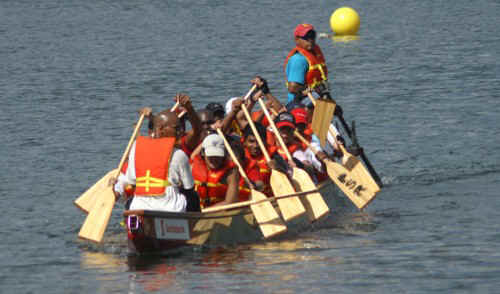
Dragon Boat racing is a new sport to Trinidad, having been introduced in
2006 to commemorate the arrival of the Chinese to Trinidad.
The standard crew complement of a contemporary dragon boat is around 22,
comprising 20 paddlers in pairs facing toward the bow of the boat, 1 drummer or caller at
the bow facing toward the paddlers, and 1 steerer or tiller (helm) at the rear of the
boat, although for races it is common to have just 18 paddlers. The drummer or caller
leads the crew throughout a race with the rhythmic beating of a drum to indicate the
timing and frequency of paddling strokes. The steerer, known also as the coxswain, helm,
steersman, sweep, or tiller, controls the dragon boat with a steering oar similar in
function to a tiller which is mounted at the rear of the boat.
An association has been formed and regular races are held, often comprised
of teams from different companies. Visit our Events Calendarto see the scheduled races. The
association can be contacted at ttdbf@wow.net
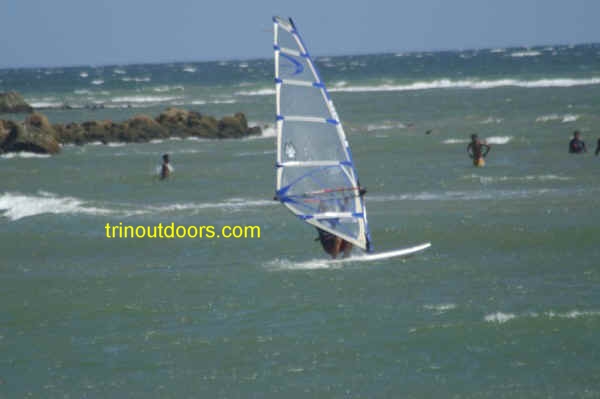
Windsurfing has a small following in Trinidad. Chagaramas and along the
west coast in the Bayshore, Westmoorings area are popular locations. Los Iros beach in South Trinidad with its constant breezes
and low level waves is another popular windsurfing location. As the beaches used by
windsurfers in Trinidad are different from those used by regular
surfers, there is little jostling for space.
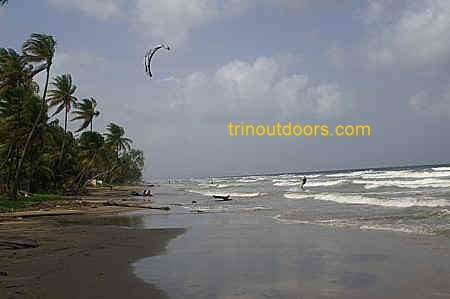
Long stretches of beach with few or no persons in the water, an absence of rocks and a
constant on-shore wind create heaven for a kite surfer. For the small band of dedicated
kite surfers in Trinidad our south coast beaches are that type of heaven. On any weekend
when the wind is above 14 knots, especially during December to June you may see
individuals kite surfing at either Mayaro, Moruga or Los Iros
beach. Persons who are interested in the sport can contact Edward Shim at Shim's Tailoring
(868-623-1655) for more informationand visit the
group "T&T
Kiteboarding Page" on Facebook for
information on wind conditions and kiting activities. For other pictures of kite surfing, visit the Photo Gallery and
enter the search term"surfing".
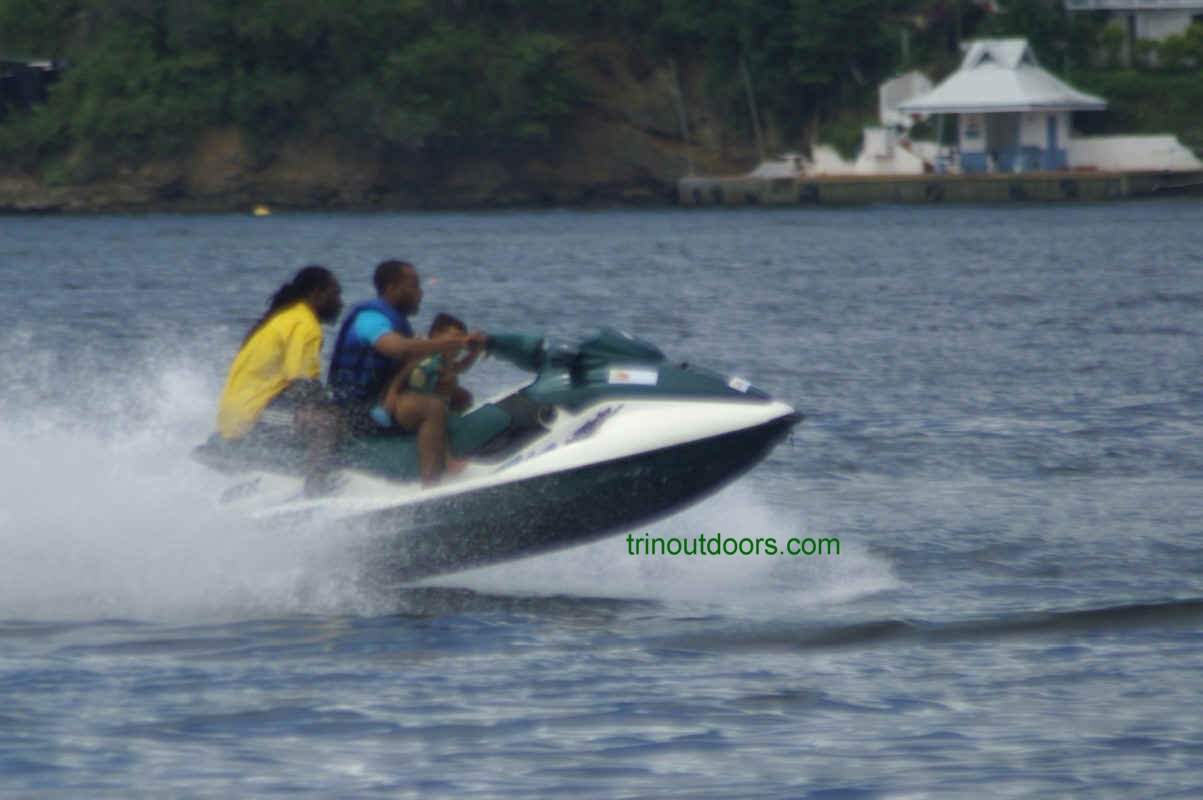
For those who like the feel of the power and the speed while zipping
across the water, the use of personal watercrafts is considered unrivalled. The relatively
sheltered waters of Chagaramas Bay with its low waves is a favored location. Jet Skis are
available for rental every day at Williams Bay, Chaguaramas. Visit the Photo Gallery for
more pictures of Jet Ski action.
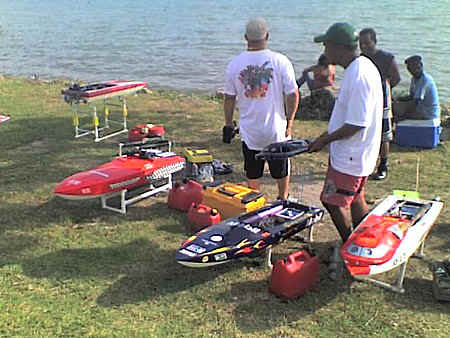
There is a model boat club that hosts regular racing competitions for
model boat enthusiasts. Mucarapo Bay in the waters in front of the lookout on the Audrey
Jeffers Highway and Williams Bay Chaguaramas are the locations most often used for these
races. These races are usually held once per month on a Sunday afternoon. On other Sunday
afternoons, members of the club gather to practice with their boats.
Model aircraft flying is an interesting hobby that is practiced by a few
dedicated aficionados mainly at the Queen's Park Savannah in Port of Spain;
although there are some persons who fly their model planes in any open area
near their homes. The group that flies at the Savannah has formed
the Queen's Park Savannah RCI Club and fly their model planes mainly on
Sunday mornings and on public holidays.
Individuals who are new to this hobby usually start by flying planes that
are trainers which are planes designed to automatically correct for pilot
errors and continue flying. As individuals acquire greater skill through
practice some persons upgrade to more demanding models such as miniature war
planes or acrobatic planes or jets or helicopters. The group at the Queen’s
Park Savannah starts fairly early in the morning between 7.30am and 8am and
engage in pattern flying and acrobatic flying. For safety reasons no more
than 4 planes fly ant any one time.
So on a Sunday or holiday morning you can visit the Queen's Park Savannah in
the area of the old sand track and see model aircraft in the air doing their
various tricks and stunts. If after seeing the planes in the air you want to
start this hobby you can buy a completely built plane or buy a kit and build
your own. Model airplane kits come either completely broken down or almost
ready to fly with just some assembly required by the owner.
For those who love the adrenaline rush of tires on a four wheel drive
vehicle, churning and slipping sideways in the mud, off road driving is a sport to
explore. Trinidad's various logging trails, cane field and agricultural dirt roads provide
the right environment for testing the ability of your four wheel drive vehicle. While it
is fun to explore new areas there is a benefit to doing that exploration as part of a
group (especially if you get stuck in the mud) and the Trinidad Off Road Club regularly
organizes group drives. Visit our Events Calendarto see the scheduled group off road drives.
Motor Car Rallies are organized in Trinidad by the
Trinidad and Tobago Rally Club, which is
responsible for the two disciplines of Navigation and High Speed Stages. The
TTRC organizes approximately 7 Events every year including the Championship
Series, a major International Rally, and numerous charitable events. The
international Rally is known as Rally Trinidad and draws
participants from throughout the Caribbean and the UK. This event is usually
held in March or April. This true off road racing with the stages being on
dirt and gravel roads. Most of the cars competing in these events are 4 WD
models but some 2WD models also take part.
Spectators are always welcome at rally events but you
must arrive before the rally starts because often the access points to the
rally are the same roads that the cars would be racing on and so once the
rally starts these access points are closed.
The thrill of Rally Trinidad 2018
Here are some scenes from the Trinidad 2013 Car Rally
Circuit Racing is one of the exciting motor sports available in Trinidad.
The sport has been operating in the country since 1966. The sole authorized
racing track is the Wallerfield Racing Circuit which is a former aircraft
runaway originally created by the US AirForce
during World War 2. After a hiatus of several years the sport has been
revitalized with the racing track being repaved and the Wallerfield Racing
Circuit reopened. The controlling body for Motor Sport in Trinidad is the
Trinidad and Tobago Auto Sports Association (T.T.A.S.A) who derive their
authority from the FIA in Geneva. The FIA is the highest international body
involved in the administration of Motor Sport.
Racing in Trinidad takes place in several groups:
Group 2 - Modified two and four seater 2WD production cars fitted
with normally aspirated piston engines up to 2,000 cc and 12A Rotary
engines
Group 3 - Modified two and four seater 2Wd production cars fitted
with normally aspirated piston engines up to 3,200 cc or 12A or 13B
Rotary engines
Group 4 - Closed wheel AWD or 2WD, engines up to 4,500 cc or 2,600
cc forced induction engine or 12A or 13B Rotary engines or 20B Rotary
engines
In addition to racing among local cars there is also the Caribbean Motor
Racing Championship Series which involves cars from Trinidad and Tobago,
Jamaica, Barbados, Guyana, Cayman Islands, Suriname, St Vincent. There are
four carded rounds in this series with one leg taking place in Trinidad.
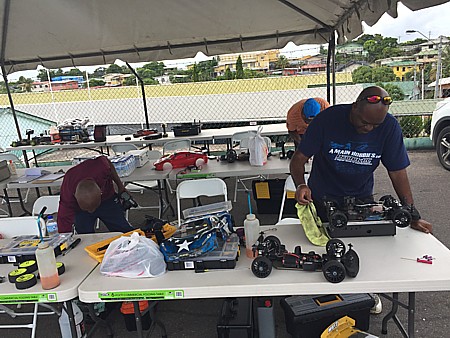
Every year children throughout Trinidad
and Tobago receive model cars as gifts and most people think of these radio controlled
cars as children's toys. However for some adults these radio controlled cars
are much more than toys, for them these cars are tools in a very serious
sport. With cars that run on a special methanol fuel mixture, tires made of
a special compound plus the ability to make fuel flow,
throttle, camber and suspension adjustments this is a serious
recreational activity. On weekends, various members meet to practice their
skill, check how their cars are operating and make adjustments to the
operation of their cars.
Throughout the year there are organized model car race meetings in various parts of
Trinidad and Tobago. The racing is done in both Off Road and On Road
categories along defined race course. The racing is also done in accordance with very specific rules
and using a sophisticated timing system.
For more information on this sport visit the web site of the Radio
Controlled Model Organization of Trinidad and Tobago at
http://www.rcmott.org/
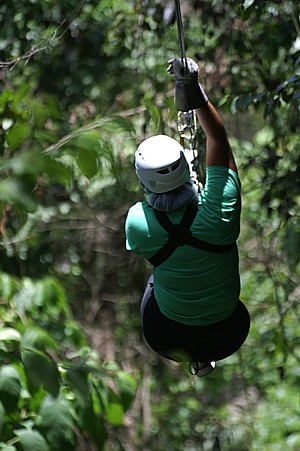
Many countries have zip-lines as a means of outdoor
recreational activity as it is an exciting way to get a panoramic
view of an area and when created high in the forest canopy it also offers
a view of the canopy that is almost impossible to achieve from ground level.
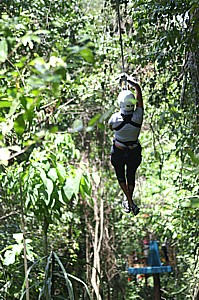
A zip-line consists of a series of cables strung along several points at an
incline. A pulley is suspended on the cables and the rider is attached by
means of a harness to the pulley. The rider then launches from a
platform and
travels along the zip-line with the rider's movement being propelled by
gravity as he travels along the cable.
Trinidad now has a multistage zip-line located in Chaguaramas in the Tucker
Valley. The zip-line has seven (7) stages beginning on the northern side of
Macqueripe Bay. The rider goes through
all 7 stages and then turns around and zips back to the beginning. The first
stage takes you over Macqueripe Bay with a
wonderful view of the bay below while the remaining stages take you through
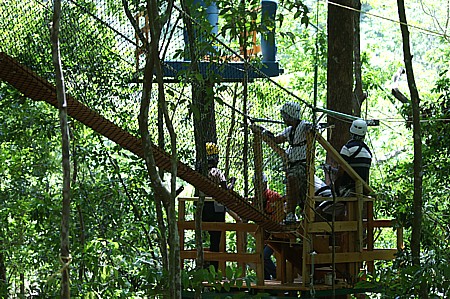
the trees up in the forest canopy. As a rider completes each stage you have
to move to the next platform as the starting point
for the next stage which is always somewhat higher than the ending point of
the stage you have just completed. Moving from one
platform to another requires walking in the tree canopy along
suspended wooden bridges providing a view within the canopy.
One of the key aspects of zip-lining is rider safety.
At Chaguaramas for each zip line stage there are two steel cables and riders
are double attached to both cables. Each rider is given a pair of heavy duty
gloves and can control the speed of their movement by holding the cable
while using their hand as a brake. In the event that a rider stalls
along the cable because of going to slowly, the rider can use their hands
and pull themselves along the cable to the next station.
The entire zipline course takes between 45 minutes and
one hour to complete and is full of excitement with one hearing howls of
enjoyment as riders move along the course.
To find the locations referred to on this page, see the Trinidad Map
All photographs (unless otherwise stated) are the property of Brian
Ramsey. None of the photographs may be reproduced without the express written
consent of Outdoor
Business Group Limited
and Brian Ramsey.